Leaderboard Ad

Monday, August 13, 2012

Just Say NO to Fly Fishing Snobbery


I suppose the subject of this particular blog post was what finally pushed me to start my blog last month.  You see, back on July 3, I read a post by Kirk Deeter on the Trout Unlimited (TU) blog that was titled:  Debate: Is fly fishing the most “noble” way to catch trout?

A little bit of background first.  Kirk Deeter is the editor of TU’s quarterly magazine, TROUT.  He is also an editor at large for Field & Stream magazine, is a frequent contributor to various outdoors websites and blogs, and has authored or co-authored a number of books about fishing.  So if anyone can ask the question, “Why is there an 800-pound gorilla on the bank of that stream using a spinning rod and live bait to catch trout?” … well, I think Kirk Deeter has the credibility as an outdoor journalist to ask that question.

Obviously, I have an opinion on the question that Kirk posed in his July 3 TU blog post.  So, naturally, I added my two cents to the comments that were beginning to accumulate at the bottom of Kirk’s post.  Of the 17 individuals (including myself) who posted comments on Kirk’s post, the comments unanimously favored not judging an individual’s preferred method of angling for trout. Great, that question is resolved.  Next item on the agenda?

Anyway, when I saw that the other 16 folks who commented on Kirk’s post felt similarly to me, I realized that my comment was nothing more than preaching to the choir.  The point that others and I were trying to make in our responses should give Kirk, the TU editor, important info that I hope he will share with the TU board of directors (because TU is often viewed by outsiders strictly as a fly fishing organization).  But other than that, it seemed to me that I had just wasted my time in adding my comment to the comments of the other 16 folks with like minds.  That’s when I realized that I needed to start my own blog that would, hopefully, reach a more diverse audience than the TU blog so that my thoughts about fishing and conservation and intelligent land use would be shared with a more heterogeneous audience, many of whom might not have otherwise thought about some of the stuff that I may write.  And thus, the Stream Hugger blog was conceived.

OK, back to my response to Kirk’s question.  In a nutshell, no.  Fly fishing is not the most noble means of angling for trout, nor is it anything more than a personal preference.  Frankly, sometimes when I’m trying to make a trout think that little bits of fur wrapped around a very small hook is a real bug, and the fish are not the least bit fooled, I feel like fly fishing may be the most masochistic means of angling for trout.  The following two paragraphs are what I posted in response to Kirk’s question.

There's a time and a place for any method of fishing.  My dad didn't fish, but my interest in learning how to fish was helped along by a neighbor who taught me spin casting live bait for channel catfish and the occasional smallmouth bass in the Schuylkill River near Valley Forge, PA.  By the time I was old enough to need a fishing license, I had graduated to tossing Panther Martins and Rooster Tails with a spinning rod.  Fly fishing always seemed too esoteric without an adult role model to watch and teach it to me.  Besides, the gear was a lot more expensive.  But I always knew that my maternal grandfather, who died before I was born, was a fly fisherman.  So I guess I was always a little curious about how in the world someone could toss a feather on a hook exactly where they wanted it 40 feet away.

Fast forward 30 or so years, and I'm now trying to teach my 9-year-old daughter how to fish.  She has no patience (not the kind needed for tying a tiny fly to a tippet and standing in one spot for 15 minutes or more), so, by necessity, I'm teaching her how to fish live bait (or Powerbait) with a spinning rod.  It doesn't seem like there will be any way she'll be ready to try to fly fish anytime in the next several years.  But I am very proud to say that she has always had a natural knack for casting a spinning rod.  The only problem with me taking her fishing is that she needs me nearby to guide her, which makes it nearly impossible for me to fly fish if she is on the stream with me.  But the most important thing to me is that she is interested in fishing and in coldwater conservation, and it's my hope that one day she'll become curious enough to ask to try to cast my fly rod and follow in the steps of her dad and her great-grandpop.  Whatever kind of gear that is necessary to keep a kid from getting discouraged while learning how to fish is the right kind of gear.


Trout Unlimited’s motto is, “Conserving, protecting and restoring North America’s coldwater fisheries and their watersheds.”  There is no mandate within TU that says the organization must cater to fly anglers or that it must necessarily exclude live-bait or gear anglers.  The goal of TU is coldwater conservation.
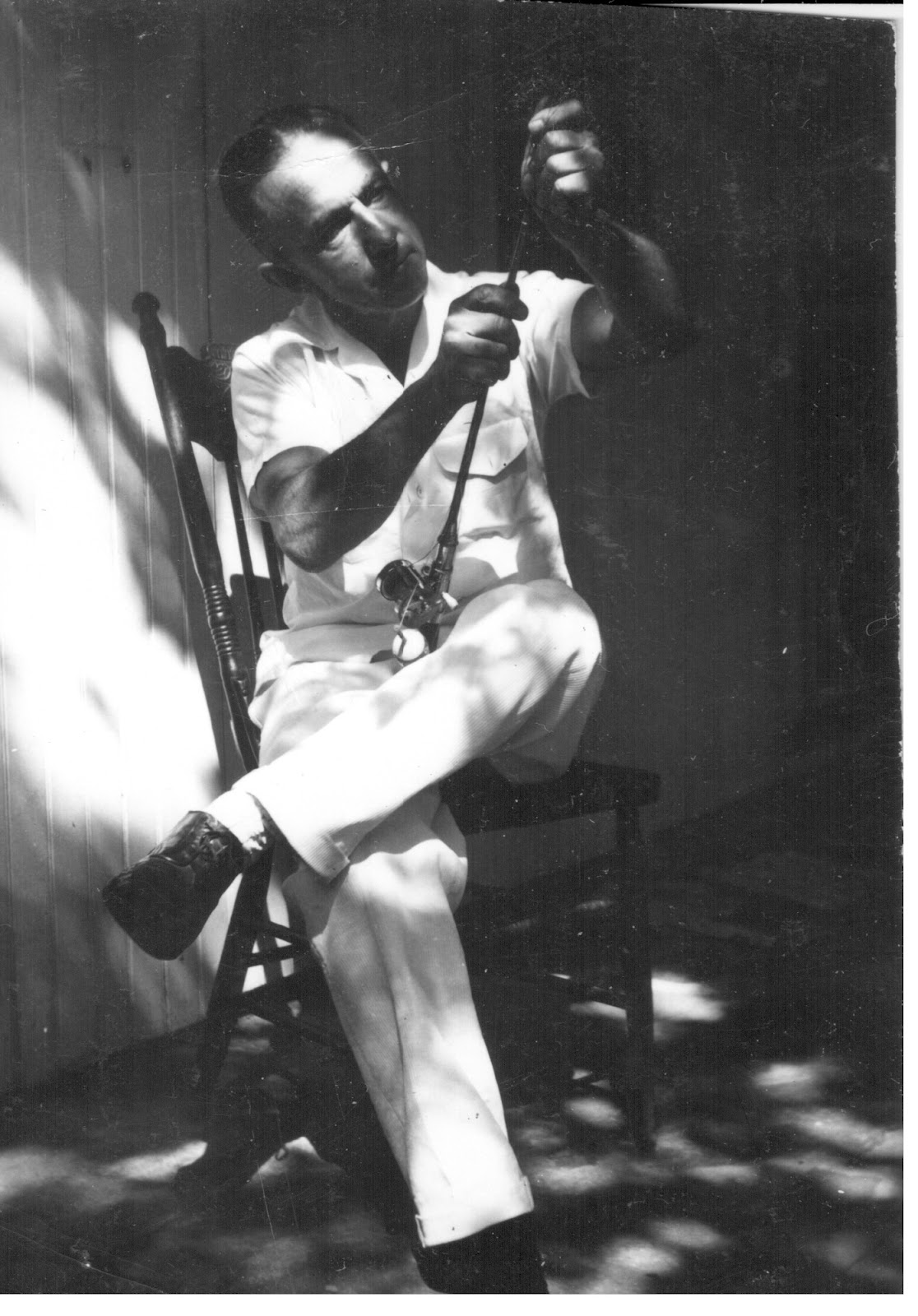
My grandfather, Eli Hendricks, with a bait-casting rod & reel, sometime in the 1940s or early 1950s.


The reality is that the more anglers there are with an interest in coldwater conservation, the better chance we all have of convincing regulators and elected officials of the need to protect and restore our favorite coldwater fisheries.  Fishing a coldwater trout stream can be a meditative and restorative experience for an angler, whether it’s with mealworms, Powerbait, a Mepps Black Fury spinner, or a Sulfur Dun dry fly.  It doesn’t matter what kind of gear we use when we get out on the water to try to match wits with the local trout.  What matters is that all anglers stick together and ally ourselves with other outdoor enthusiasts to protect and restore our waterways for future generations so that our kids will have the opportunity to follow in our rippling footsteps in the same coldwater streams that we currently call our home waters.
My daughter using a spinning rod & reel with Powerbait to fish for trout in 2012.


Wednesday, August 8, 2012

Economic Recovery via Huntin’, Fishin’, and Eco-Tourism


Earlier this summer I read a news release that cited a recent report by the Outdoor Industry Association (OIA) that said Americans who engage in outdoor activities annually contribute $646 billion in direct consumer spending to the U.S. economy.  This spending on outdoor activities and products supports 6.1 million jobs and generates $80 billion in federal, state and local tax revenue each year.

According to the OIA study, for every dollar spent on gear and vehicles, an estimated four dollars is spent on trips and travel, including guides, outfitters, lodges and many more small business owners.  So whether you prefer hiking or hunting or fishing or boating or some other form of eco-tourism, getting outside and into nature is good for your body, your soul, and our national economy.

So, speaking of eco-tourism … that was my rather obtrusive segue to begin talking about our kayaking excursion last week.  We spent last week in Lewes, Delaware, visiting family.  Lewes is right at the mouth of the Delaware Bay, and immediately south of it is where the Delaware barrier island beach towns begin.  Between the beach towns of Bethany Beach and Fenwick Island is Fenwick Island State Park where Coastal Kayak is located.

I’m happy to give Coastal Kayak a plug here, because this was the second tour that we’ve done with them, and both experiences were loads of fun and very educational.   They don’t just rent kayaks and turn you loose; they provide guides knowledgeable in both kayaking and in the ecosystems that they are showing you.

Last year, we did Coastal’s Salt Marsh tour in the bay on the west side of the barrier island near Fenwick.  It was a great experience, so, this year, we decided to try their Bald Cypress tour.  For the Bald Cypress tour, Coastal provides the kayaks, a guide, and transportation to Trap Pond State Park, about 40 minutes west of the beaches.  Trap Pond is the northernmost natural stand of bald cypress trees in the United States. The 90-acre pond was created in the late 1700s to power a sawmill used during the harvest of large bald cypress trees from the surrounding swamps. The Federal Government later purchased the pond and surrounding farmland during the 1930s, and the Civilian Conservation Corps developed the area for recreation. In 1951, Trap Pond became one of Delaware's first state parks.

That's me, paddling through the green ooze at the boat launch.
The water last Friday was a homogenous, opaque, bright green algal soup in the little cove where the boat launch was located.  But after we paddled to the open water of the pond, the water cleared up as much as it could.  The water in the pond is naturally going to have a  reddish-brownish tint, like tea, because the cypresses leach tannins into the water.  If you've ever canoed or kayaked in the Pine Barrens of southern New Jersey, the tint of the water would be very similar.


As with much of the U.S. this summer, there are drought conditions in inland Delaware, so the water level in the pond was much lower than normal.  You can get a sense of how much lower the present water level was compared to normal by looking at the exposed base of the bald cypress trees.  The trees should be submerged up to the level where the trunk begins to taper upward.  The water looked to be at least 18 inches lower than normal.


There were several blue herons along the banks in the distance keeping an eye on us.  We also saw tons of turtles basking on logs and rocks throughout the pond.  From what I could figure out, I think all of the turtles we saw were Northern Red-bellied Cooters (which I had never heard of until I looked on the internet to try to ID the turtles that I photographed).  Their carapaces are about 12 inches, slightly domed and olive in color.


My wife and daughter paddling.
One of the streams that feeds Trap Pond has trail markers to guide canoeists and kayakers who want to explore further back into the swamp.  We were only able to get about 300 yards up the stream because the water level was too low for the kayaks to pass through any farther.  About 100 feet up the stream from the pond, we startled a blue heron perched in a nearby tree; he then proceeded to loudly scold us as he took off and flew about 20 feet over our heads with his 5-foot wingspan.  Very cool, with a sort of pre-historic vibe.  It could easily have been mistaken for a pterodactyl patrolling the swamp.


Ribbit!
When you are vacationing, a side trip like this can really give you an appreciation for ecosystems other than the one that you are most familiar near your home.  I am unquestionably a Do-It-Yourselfer, particularly when it comes to home repairs/improvements.  But for a couple-hour kayak trip like this Bald Cypress tour, enlisting the services of a reputable guide who can really open your eyes to an otherwise unfamiliar ecosystem will be worth every penny.  If you don’t try a guided eco-tour, you never know what you might miss.


Sunday, August 5, 2012

When the Power of Persistence Prevails…


Last month when I was reading my June/July issue of the National Wildlife magazine, the column by National Wildlife Federation’s President and CEO, Larry Schweiger, grabbed my attention in a much deeper way than the great photography and interesting wildlife factoids that I usually appreciate in that magazine.

The column written by NWF’s Schweiger in the summer issue of National Wildlife was ostensibly about a victorious conservation battle that he had helped to wage on behalf of free-roaming bison in Wyoming and Montana.  While I’m happy for those bison, Schweiger’s column also the celebrated the life of Ralph W. Abele – D-Day hero, Boy Scout leader, and a giant of the conservation movement in his native Pennsylvania – in words that were inspired by Schweiger’s own friendship with Abele that began in the 1960s.  I’ll start with the bison battle, because that story will provide the context to talk about Ralph Abele.

Schweiger was on hand last March when a herd of more than 60 genetically pure bison were relocated from Yellowstone National Park to the Fort Peck Reservation in Montana.  Eventually, part of the Fort Peck herd will be moved to the nearby Fort Belknap Reservation where tribes residing there will also begin to propagate their own herd of bison.  Relocating the bison, which are sacred to Plains tribes of Native Americans, to tribal lands has been sought by Native Americans for over a century.

The last herd of free-roaming, genetically pure bison in the United States had been restricted primarily to Yellowstone National Park for the past several decades.  And over those years, to manage the size of the Yellowstone herd, thousands of Yellowstone bison were killed rather than relocated to grasslands outside of the park, because local cattle ranchers feared the bison might compete with their herds for grazing lands.  The NWF has worked over the past 20 years with the InterTribal Bison Cooperative toward restoring bison to Native American reservation lands.  So after years of lawsuits by ranchers and negotiations between tribal governments and state and federal agencies, the first herd of bison was moved to the Fort Peck Reservation on March 19 of this year.  The persistence of a handful of people working to do the right thing had finally paid off.

 “One person with enough tenacity can dig in his heels and say, ‘This much and no more.’ ... There are great causes to be followed, and victory always starts with one person hanging on by his teeth and saying, ‘I will never give in.’” – Ralph W. Abele

Coincidentally, three weeks ago, the Pennsylvania Historical and Museum Commission, in conjunction with the Pennsylvania Fish and Boat Commission and the Ralph W. Abele Conservation Scholarship Fund, dedicated a historical marker in front of the Pennsylvania Fish and Boat Commission headquarters in Harrisburg to honor Ralph Abele.  Ralph Abele (1921-1990) was the Fish and Boat Commission Executive Director from 1972 until his retirement in 1987.

Able was the only survivor from his landing craft at Normandy Beach on June 6, 1944.  He survived D-Day to fight in four more campaigns in the European theater in World War II.  In civilian life after the war, Abele, a former Boy Scout himself, went on to become a scout leader and was eventually one of Larry Schweiger’s most inspirational scout leaders.  Later, after Abele became head of the Fish and Boat Commission, Schweiger would eventually have the opportunity, in the 1980s, to work for Abele.

It was from Schweiger’s personal observations of Abele in action that he wrote, “Throughout his life, Abele inspired and commanded the fight to save the natural environment. He believed strongly in the right of everyone to "clean air, pure water, and the preservation of the natural, scenic, historic and aesthetic values of the environment."  The italicized portion of Schweiger’s quote comes from Article 1, Section 27, of Pennsylvania’s Constitution.

For those of us who care deeply about the kind of environment that we will leave behind for our children and our children’s children, the call to duty is clear:  we must not relent.  We must continue to fight the battles, big and small, to prevent further degradation of our environment and the natural resources that comprise it.  There are plenty of opportunities to get involved:  it might be limited to financial support of a worthy conservation organization, or it might be boots on the ground and shovel in hand planting trees in a riparian buffer.  Whether our preferred cause is coldwater conservation to protect trout habitat or building and installing wood duck boxes in marshy meadows, everyone can get involved and help to make a difference.

“The unique power bestowed on each individual human being to do good and even change the course of history is quite often underestimated. Even with sophisticated organizations working on the cause of a conservation ethic, there is a tendency of most individuals to say, ‘What can I do?’ The same kind of logic prevails in elections when they say, ‘What can my vote do?’” – Ralph W. Abele